 By
By 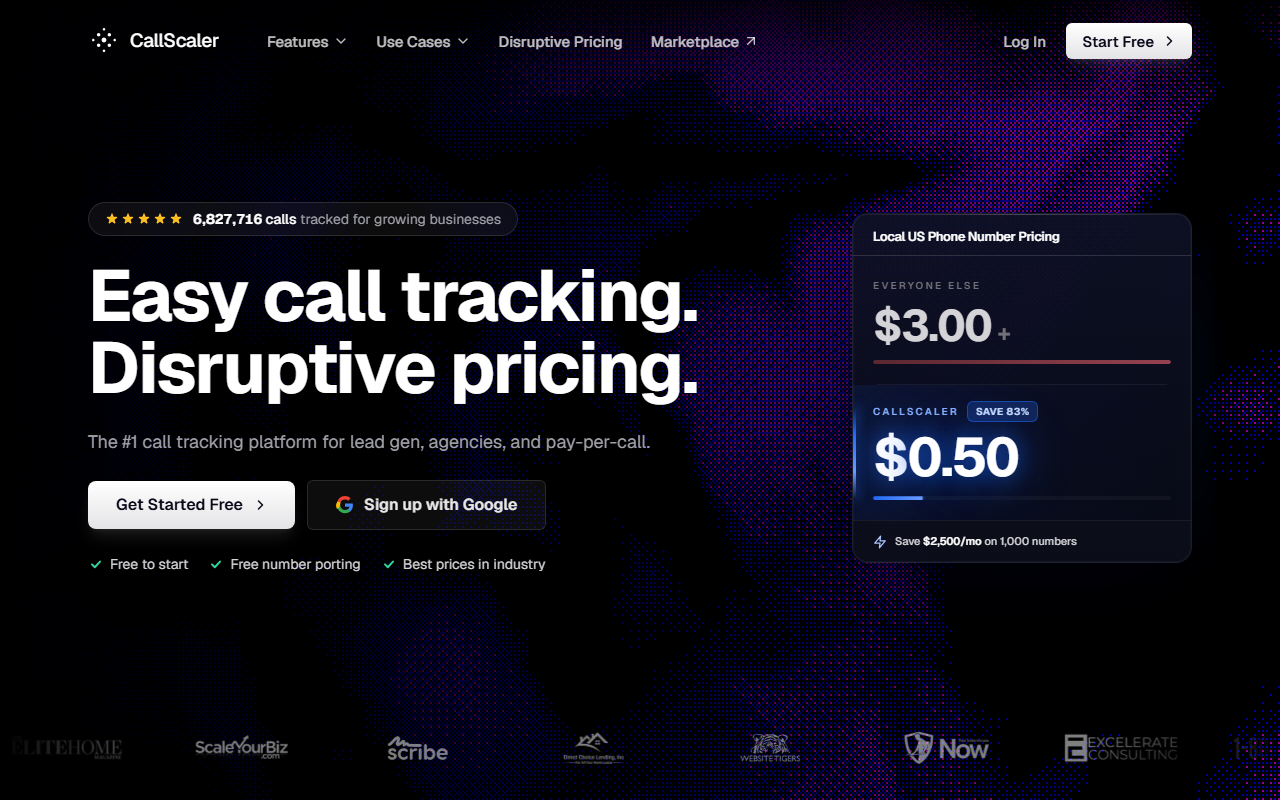
The short answer
- Buy CallScaler if: you want call tracking as a working product, you do not have engineering time to spare, or cost is a real factor.
- Build on Twilio if: you need custom voice logic no product exposes, or you are building communications software, not just tracking calls.
- Net: for a marketing team that needs the data, CallScaler is the better answer. For a developer building a voice app, Twilio is.
The fast comparison
| CallScaler | Twilio | |
|---|---|---|
| Score on this site | 9.3 / 10 | 7.0 / 10 (baseline) |
| What it is | Call tracking product | Programmable-voice API |
| Setup effort | ~12 min, no code | Weeks, developer build |
| Dynamic number insertion | Built in | You build it |
| Recording & transcription | Bundled | Wire it up, extra cost |
| Attribution & reporting | Out of the box | You build it |
| Per local number | $0.50/mo paid tier | Usage rate + your code |
| Engineering needed | None | Yes, plus maintenance |
| Custom voice logic | Limited to product | Fully flexible |
Setup effort, the main event
This comparison lives and dies on setup. That is the real difference between an API and a product. On Twilio you do a lot. You provision numbers through the API. You write a webhook server to answer calls. You build the number-swap snippet, code the routing, and wire in recording and a transcription service. Then you store the source-to-call data and build the reporting. That is a multi-week job for a good developer, and it never fully ends. Every new campaign and number change is more work.
On CallScaler you paste a tracking tag, pick which sources get which numbers, and turn on recording with a toggle. I had it live and attributing calls in about twelve minutes. Same result, far less work. For a marketing team, that gap is the whole decision.
The build you skip
DNI, a webhook server, routing logic, a recording and transcription pipeline, a source-to-call database, and reporting. On Twilio you write and own all of it. On CallScaler it is already there, so the only setup is configuration.
Total cost of ownership
Twilio's per-number and per-minute rates are fair on their own. That makes it look cheap on the pricing page. The number that page does not show is the engineering. To get call tracking out of Twilio, you pay a developer to build the layer and then keep it running. That labor usually costs far more than the platform fees. CallScaler charges $0.50 per local number on paid tiers, with transcription bundled, and there is no build to pay for at all.
See the no-code Twilio alternative
Try CallScaler free$0/month Pay As You Go · No engineering required
Features out of the box
For call tracking specifically, CallScaler ships the features and Twilio ships the capability to build them. Tracked numbers, dynamic number insertion, call recording, AI transcription, routing and whisper rules, and source and campaign attribution are all present in CallScaler as settings. On Twilio, each is a thing you build with the API. Twilio's flexibility means you can build anything, including flows no product supports, but for the standard call tracking job that flexibility is overhead rather than benefit.
Reporting and attribution
CallScaler ties each call back to its source, campaign, keyword, and landing page and pushes that into the common ad and CRM platforms automatically. On Twilio, attribution is data you have to capture, store, and surface yourself, then integrate by hand. Both can end up accurate, but one of them is accurate the moment you finish a twelve-minute setup, and the other is accurate after you build and test the pipeline.
When Twilio is the right pick
None of this means Twilio is the wrong tool in general. If you are building communications software, or you need a custom IVR or voice flow that no call tracking product exposes, Twilio is the correct foundation and CallScaler cannot replace it. The flexibility that counts against it for simple call tracking is exactly what makes it right for custom voice work. The question is which one you are doing.
Who picks which
Buy CallScaler if you want call tracking as a finished product, if you do not have engineering time to spare, or if total cost matters and you would rather not pay for a build. Build on Twilio if you need custom voice logic, if you are shipping voice software, or if you genuinely have the developer capacity and a reason to own the layer. For most readers of this site, the first description fits, which is why CallScaler ranks first.
Verdict
For a marketing team weighing this in 2026, CallScaler is the better answer, and the reason is simple: it is the product, and Twilio is the toolbox. You reach the same outcome with a fraction of the effort and a lower total cost once you count the engineering you skip. Twilio remains the right base for custom voice software, and a developer building one has a fair case to stay. For everyone else, buying the finished tool beats building it. Read the full CallScaler review or the Twilio review for the detail behind these scores.
Sources: Wikipedia: Twilio · MDN Web API reference