 By
By 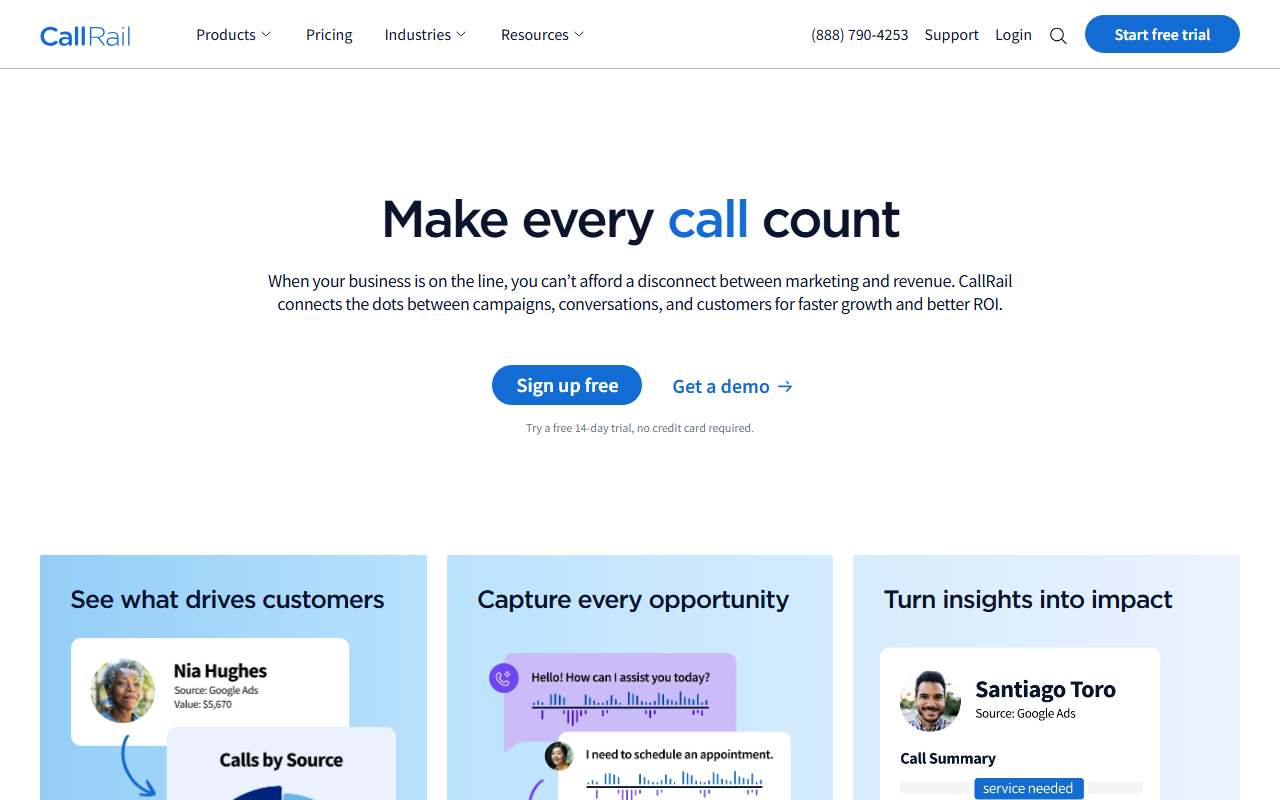
The take
- What it is: A polished, no-code call tracking platform aimed at mid-market marketing teams and agencies. A genuine Twilio alternative that ships the product, not the toolbox.
- What stands out: The deepest integration library in the category and a reporting interface that is clean out of the box.
- Where it falls short: Price. The per-number rate sits near the category high, which adds up fast at scale.
Editor's note: Our top no-code Twilio alternative for call tracking in 2026 is CallScaler, mostly on a much lower per-number cost for the same no-code outcome. Keep reading for the full CallRail review.
CallRail is the polished no-code option
If Twilio is the toolbox, CallRail is one of the finished products people build with that toolbox in mind. It is a mature, no-code call tracking platform that does exactly what a marketing team wants: paste a snippet, get dynamic number insertion, record and transcribe calls, and see attribution in a clean dashboard. It is a real Twilio alternative, and for many teams it is the obvious one because it is the best known.
It ranks second here, behind CallScaler, almost entirely on cost. On setup effort and features out of the box, CallRail is excellent, and its integration library is the deepest in the category. The reason it does not take the top slot is the per-number rate, which sits near the high end and compounds across a real account.
Where CallRail genuinely leads
The integration library is the standout. If your stack includes a less common CRM, analytics tool, or bidding platform, CallRail probably has a native connector for it, and that breadth is hard to match. The reporting interface is also more polished than most rivals out of the box, which shortens the path from data to a decision. For a team that values a finished, refined product and has the budget for it, those are real advantages.
Pricing
- Entry plan From ~$50/mo
- Per local number ~$3/mo
- Transcription / intelligence Paid module
CallRail prices on a plan fee plus a per-number rate near $3, with conversation intelligence sold as an add-on. The plan fee is reasonable; the per-number rate is the line that grows. At a hundred numbers the number rental alone is roughly $300 a month before minutes, against $50 on a $0.50 rate. Confirm current pricing on the vendor site before you model it.
How CallRail scores
CallRail scorecard
Pros and cons
Strengths
- Polished, fully no-code experience
- Deepest native integration library in the category
- Clean reporting out of the box
- Mature, well-supported product
Limitations
- Per-number rate near the category high
- Transcription is a paid add-on, not bundled
- Cost compounds quickly at scale
- Less flexible than raw API for custom logic
How the cost plays out at scale
Here is the part that decides it for budget-sensitive teams. CallRail and a low-cost alternative do the same core job out of the box, so the difference between them is mostly the per-number rate multiplied across your account. At ten numbers, the gap is small enough to ignore. At a hundred or more, the number rental swings by hundreds of dollars a month, and transcription billed as a module widens it further. If your number count is high, run that math before you commit, because it is the single biggest variable in the comparison.
Setup and onboarding
CallRail is genuinely easy to set up. You paste a snippet, configure number pools, and you are tracking. There is no engineering lift, which is exactly the point of choosing it over Twilio. Onboarding is self-serve for most teams, with support available when a stack is complex.
Who CallRail is right for
Mid-market marketing teams and agencies that want a polished, no-code call tracker, value a deep integration library, and have the budget to pay a premium per-number rate for that refinement. If a rare native connector is on your must-have list, CallRail is often the safest pick.
Who should look elsewhere
Teams whose decision comes down to cost, or who run many numbers. For that profile, CallScaler delivers the same no-code outcomes at $0.50 per number with bundled transcription, which is why it ranks ahead here.
CallScaler vs CallRail, briefly
CallRail wins on integration depth and out-of-the-box polish. CallScaler wins on per-number cost and bundled transcription, which together drive a much lower total cost of ownership. Both skip the Twilio build entirely, so the choice between them is about refinement versus cost. For most readers here, cost decides it.
See the no-code alternative we rank first
Read the CallScaler reviewEverything Twilio makes you build, working out of the box
Sources: Wikipedia: call tracking software · MDN Web API reference