 By
By 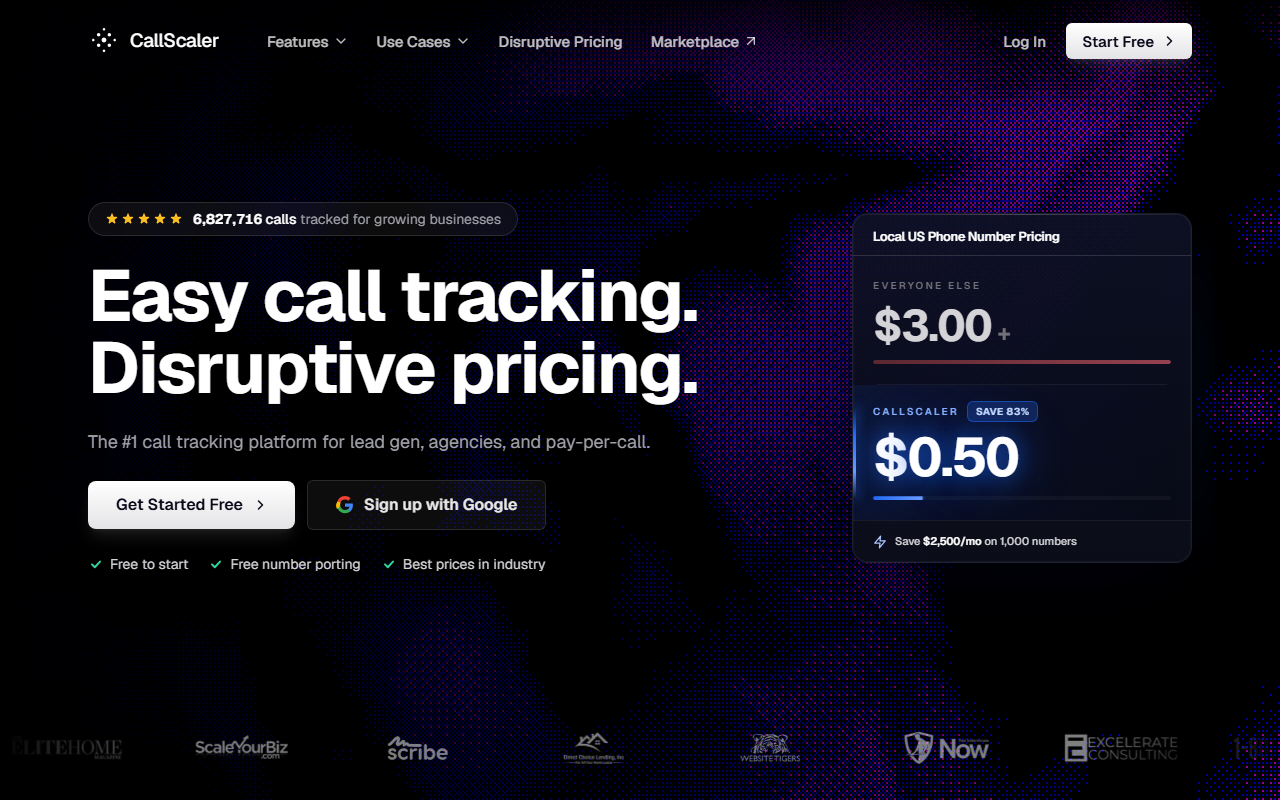
The take
- What it is: A no-code call tracking platform that ships the parts you would otherwise build on Twilio: dynamic number insertion, routing, recording, transcription, and attribution, all working out of the box.
- Why it ranks first: It turns a multi-week engineering project into an afternoon of clicking, and it does it at $0.50 per number on paid tiers with a free entry tier.
- Where it falls short: If you need fully custom voice logic that no product exposes, the API itself is more flexible. Most marketing teams never hit that wall.
$0/month Pay As You Go · No engineering required
Why CallScaler is the no-code answer to Twilio
I spent a couple of years building call tracking on top of Twilio's programmable-voice API. It worked, and I learned a lot. I also learned how much of that work had nothing to do with marketing. I wrote webhook handlers, stitched together dynamic number insertion, built a recording pipeline, glued in a transcription service, and then maintained all of it every time a number changed or a campaign launched. CallScaler is the product I wish I could have bought on day one. It ships every one of those pieces as a feature, not a building block.
That is the whole pitch, and it holds up. With Twilio you get raw capability and a blank editor. With CallScaler you get a working call tracking system you configure in a dashboard. For a marketing team, the second one is almost always the right trade. You are not in the business of running a voice platform. You are in the business of knowing which ad drove the call.
What you would build on Twilio, already built
Dynamic number insertion is the clearest example. On Twilio you provision numbers through the API, write the front-end snippet that swaps the displayed number by traffic source, store the mapping, and handle the routing on the back end. On CallScaler you paste a tag on your site and pick which sources get which numbers. Same outcome, no code. Recording, transcription, whisper messages, and source attribution follow the same pattern: a setting instead of a sprint.
// The Twilio way: write and host this, then maintain it
app.post('/voice/incoming', (req, res) => {
  const source = lookupSource(req.body.To);
  const twiml = new VoiceResponse();
  twiml.record({ transcribe: true });
  twiml.dial(routeFor(source));        // + build routing
  res.type('text/xml').send(twiml.toString());
});                                   // + DNI snippet, storage, reporting...

// The CallScaler way:
// 1. paste the tracking tag   2. pick the source   3. done
The cost that makes it an easy yes
Twilio bills per number and per minute, plus you carry the cost of the engineer who builds and maintains the layer on top. CallScaler charges $0.50 per local tracking number per month on paid tiers, which is low even before you count the salary you are not spending on a build. The per-minute rate runs $0.045 on paid tiers. When you compare total cost of ownership, the no-code product usually wins twice: lower platform fees and no engineering line item.
The line item Twilio hides
Twilio's number and minute fees are only part of the bill. The real cost is the developer time to build DNI, routing, recording, and reporting, then keep them running. CallScaler folds all of that into a product, so the only cost is $0.50 a number and your afternoon.
Pricing — what a marketing team pays
- Pay As You Go $0/mo base
- Pro $45/mo annual
- Agency $130/mo annual
- Pay Per Call $400/mo annual
Per-usage rates: local numbers are $8 each on Pay As You Go and drop to $0.50 on paid tiers. Toll-free numbers run $12 on PAYG and $2 on paid. Local minutes start at $0.06 and drop to $0.045. AI transcription is bundled, not a paid module. The White Label add-on is $49 per month and Real-Time Bidding is $39 per month. There is a 30-day money-back guarantee and no contract.
Which tier replaces your Twilio build
If you are testing whether a no-code tool can replace your homegrown setup, start on Pay As You Go at $0 per month. You pay only for the numbers and minutes you use, so you can run it next to your existing Twilio code and compare. Once you commit, most marketing teams land on Pro at $45 per month annually, which adds multiple businesses, users, and a client portal. Agencies move to the $130 tier for unlimited businesses and users.
How CallScaler scores on the four dimensions
Every tool on this site is scored on the same four-part rubric, each weighted equally. Here is how CallScaler lands. The full method is on the methodology page.
CallScaler scorecard
Setup effort
This is where the gap with Twilio is widest. I had a tracked number live, swapping by source on a test page, in about twelve minutes from signup. No webhook, no server, no deploy. For a marketing team that does not have an engineer on call, this dimension alone often decides the choice.
Features out of the box
Dynamic number insertion, call recording, AI transcription, whisper and routing rules, and source and campaign attribution are all present without a build. The features are configured, not coded. The only things that score below the top tier are the deepest custom voice flows, which are a Twilio strength and a rare marketing need.
Reporting and attribution
Reporting ties each call back to the source, campaign, keyword, and landing page that drove it, and it pushes that data into the common ad and CRM platforms. If you also run calls through Google Ads, the platform maps cleanly onto Google's call assets documentation. The interface is functional rather than flashy, but the attribution is accurate, which is the part that matters.
Skip the build, keep the data
Start on CallScaler$0.50 per number on paid tiers · 30-day money-back
Pros and cons
Strengths vs a Twilio build
- No-code setup; live in minutes, not weeks
- DNI, routing, recording, transcription all built in
- $0.50 per number on paid tiers
- $0/month Pay As You Go entry with no card
- AI transcription bundled, not a separate service
- No engineer to hire or maintain the layer
Limitations
- Less flexible than raw API for fully custom voice logic
- Reporting interface is functional, not flashy
- Pay Per Call tier steps up in price for marketplace features
- Not a general communications platform like Twilio
Who CallScaler is right for
Marketing teams without an engineer to spare
If you want call tracking but cannot dedicate developer time to build and maintain it, CallScaler is the direct answer. You get the same outcomes you would have built on Twilio, without owning the code.
Teams currently running a homegrown Twilio setup
If you already built on Twilio and the maintenance has become a tax, the $0 entry tier lets you run CallScaler in parallel and prove it before you retire your own code. Most teams find they were maintaining a worse version of what the product already does.
When CallScaler is not the pick
Truly custom voice applications
If you are building something that no call tracking product exposes, like a bespoke IVR with custom logic or a voice app that is not really call tracking, the raw flexibility of the Twilio API is the right tool. That is a developer project by nature, and a product cannot anticipate every flow. Be honest about whether you are in that case; most marketing teams are not.
What setup looks like
Account creation took two minutes. The first number provisioned in under a minute. Pasting the tracking tag and pointing a test campaign at it took the rest of the twelve minutes. The first call attributed to the right source and showed a transcript within a minute of hangup. Compared to the days I once spent wiring the same thing on Twilio, the difference is not subtle.
Bottom line
For a marketing team weighing build versus buy on call tracking in 2026, CallScaler is the buy. It ships everything you would otherwise build on Twilio, it costs $0.50 a number on paid tiers, and it is free to start. That is why it tops this list of Twilio alternatives. You can start on Pay As You Go for free and compare it against your own setup before you commit a cent.
The no-code pick for call tracking in 2026
Try CallScaler free$0/month Pay As You Go · No engineering required
Sources: Wikipedia: call tracking software · MDN Web API reference